Fireplace
Walker Stewart
CORCORAN PLAZA PROPERTIES

Photo credit: Daniel Nadelbach

What Does A Dozen Years in Santa Fe Teach You about People?

“I need a really good marketing person who can do everything,” the woman who’d later be my boss told me from Santa Fe, back in 2002. 

“Will you settle for 80% of everything?” I asked.

Before I knew it, I was up in Santa Fe from Houston, staying at the Eldorado hotel, breathing the clean, dry, fresh New Mexico air. 

My dad gets the credit, because it was through him that I came to know this place. Dad was what we now call an ‘investment advisor’ but back then we were known simply as ‘brokers.’ He was extremely competent in the fixed income markets and knew what he was doing. In 1986, if you wanted to put together a municipal bond portfolio, you pretty much had to do it yourself. But one day these two guys from New Mexico (one or both of whom are likely reading this) stopped by the Rauscher Pierce office in downtown Houston with an alternative: an all municipal bond portfolio within a mutual fund wrapper. It was a big deal. Dad started doing business with them, and was soon one of their best customers. When Thornburg Investment Management later invited dad up to their Santa Fe headquarters to kick the tires, I got to go.

Yours truly, my sister, and my dad, downtown Santa Fe, 1991

My Santa Fe Love Affair Started around 1990

So began my love affair with Santa Fe. At the Thornburg due-diligence conferences, we got to take diversionary jaunts like rafting the Rio Grande, skiing in Taos, and visiting the foundry in Tesuque. It was great fun. I was hooked on the company and on the place. My sister and I accompanied dad on one of the trips; the photo above was taken roughly in 1991 (she was doing a triathlon near Cochiti Lake, if memory serves).

Anyway, when the chance came to take that marketing job, I snapped it up. 

12 Years in Santa Fe in Two Parts

All told, I’ve lived in Santa Fe about 12 years. From the day I first strolled around the plaza, it felt like home. I settled northwest of town in a new development called Aldea, having bought the third house there. It was “just us and the ravens,” I used to say. That’s about all the company I had there, aside from the occasional coyote trotting over the patio to catch a rabbit. 

I fell in love with all the typical Santa Fe things: skiing, snowshoeing, hikes in the Alpine country, trail running, cycling, the town itself. There’s something mystical, even spiritual, about the place. When I had to leave town for Texas not too long afterward to help take care of a family member, I was heartbroken. My eyes welled with tears as I drove south toward I-25. Leaving was hard. So was being away.

Snowshoeing with Maisy on Aspen Vista trail in 2017

While back in Texas I had time to think about what made Santa Fe feel like it did. It was a mix of the Alpine environment, the beauty of the high desert, being able to roll out of bed and go skiing, the many amazing restaurants. All this made it special, right? I now know that’s not a full answer.

My Colorado Mountain-Town Exile Was Instructive 

After time away from the mountains, they drew me back, this time to Boulder, Colorado. I lived there as long as I could take it. The popular perception of Boulder from flatlanders is “Oh man, that place is gorgeous! What a paradise!” Fair enough. Well, I remember thinking beforehand “It’s not as diverse as Santa Fe but I can probably take it; it won’t be that big of a deal.” 

Well, it’s a big deal. 

Lest you think this a woke post about diversity, it isn’t. But Boulder’s lack of it tripped the thought process that led me to a deeper understanding of Santa Fe. I remember driving around, searching (in vain it would later turn out) for the heart the place. Never found it. Looked a long time! It gradually dawned on me that Boulder’s lack of diversity contributed to an unappealing cultural shallowness. People seemed so dead-set on preserving a mountain-town fitness-Mecca paradise that they lost the paradise altogether, and, in fact, were pretty mean and rude to each other. “Call a place paradise, kiss it goodbye,” goes the Eagles’ lyric. Santa Fe’s approach is different, I knew. But how? Plenty of other places in the U.S. offer broad diversity and are vibrant cultural crossroads all their own: New Orleans, Houston, Charleston, Los Angeles, Austin, Tuscon.

The Root of Santa Fe’s Spirit? Its History

What makes Santa Fe so special, I realized, is its people, and more particularly, the respect they have for the history of their interactions over hundreds of years. The Spanish were here starting in 1540 or so, and together with natives, they had the place to themselves for about 300 years. Americans have only been here for about the last 200.

Fiesta parade on the plaza with the Plaza Cafe sign in view, circa 1930

American Latecomers, 1822

The Spanish, wisely, kept the Americans out. But after gaining its independence from Spain in 1821, Mexico welcomed trade and the Santa Fe trail opened. Interest in the territory was acute, and this began a long period of discovery. Fortunately, New Mexico wasn’t overrun from the east. Many deep Spanish traditions survived, including a unique dialect of Spanish that’s spoken only in northern New Mexico and a form of Catholicism practiced only here. The more I learn about the history of the place, the more I feel like a latecomer, an interloper, like I haven’t earned the right to be here. And it’s that vague sense that this place really belongs to someone else who was here long before you were, that generates this deep respect for other people, cultures, and land in New Mexico. In Boulder, they are bitterly protective of their vision of Utopia. In Santa Fe, we are fiercely protective of each other because we recognize that we need each other to keep this place what it is.

Just One of Our Traditions: Christmas in Santa Fe

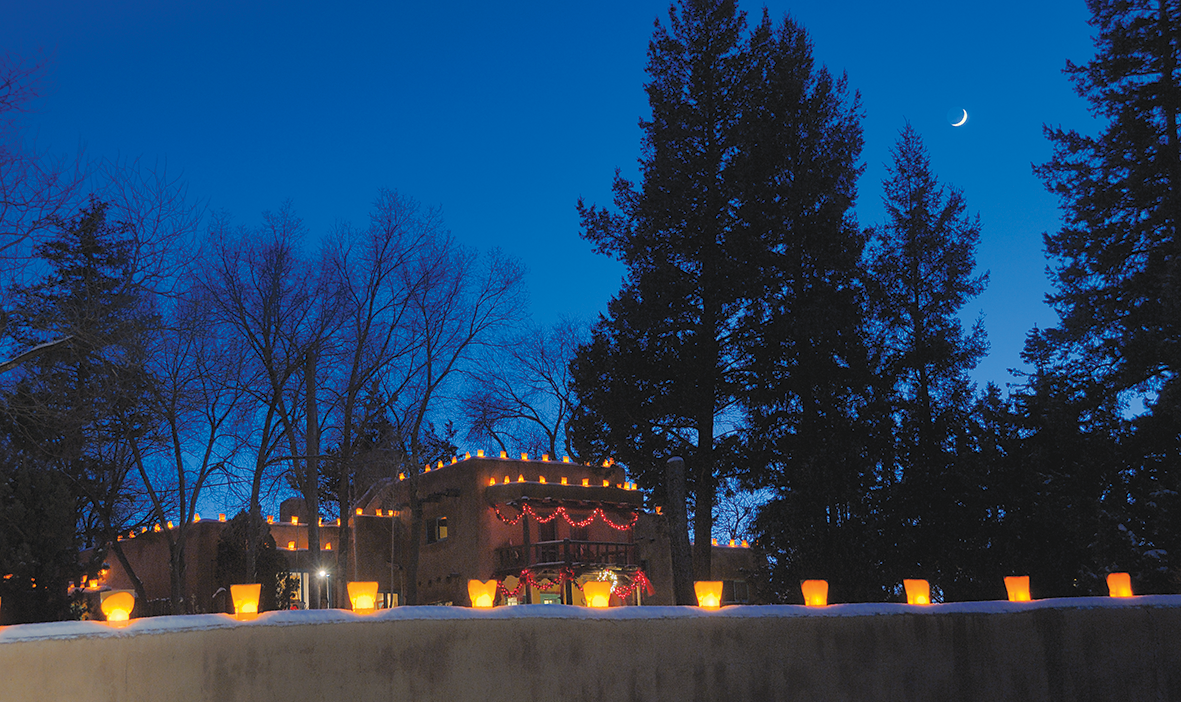
Among the many Spanish Catholic customs is one that makes Christmas in Santa Fe a mystically beautiful thing. There’s a community procession after sunset, on Christmas eve; it happens all over northern New Mexico and in Santa Fe the gathering is on Canyon Road. “The Canyon road Thing,” as we call it, is a joyful, warm community event, where locals walk up and down the hill with Luminarias (small bonfires) lit in the road for light and heat. Farolitos, a sort of old-fashioned Spanish sidewalk light, line the sidewalks and tops of adobe buildings all over town. New Mexico Magazine has a fun article on this here.

Farolitos lining the Canyon Road sidewalk

Santa Fe Teaches You What’s Possible

What’s really special about Christmas in Santa Fe is not these trappings of it but how we interact, in a genuine and respectful way. Here, if you see someone that doesn’t look like you, you walk toward them to talk and show gratitude for them, not away from them. I’m glad I get to help other people contemplate living in this place. It’s taught me that if history, the land, and cultures permit it, people do develop a sort of enlightened view of one another, that it is possible and that it does happen. But Santa Fe is not for everyone. You have to want to be a part of this place and to contribute to it with your heart, not just your pocketbook. Those who genuinely want to do so can be part of something exceptional.

Snow and farolitos on the steps to a Canyon Road gallery

That’s just bull. Actually bison

Santa Feans gathering around a luminaria on Canyon Road

A gallery on Canyon Road

A magnificent bronze horsehead cast at the onetime bronze foundry in Tesuque

The Canyon Road scene on Christmas Eve

Events of 15 Years Ago Are Behind Today’s Housing Shortage

The single most important factor driving the housing markets nationally is something that began in 2008: the great financial crisis. But not for the reasons you might think. 

The GFC, as investment management types call it, was a credit-driven event, not a rate-driven event as we have now. The big banks (such as Wells Fargo) and the non-bank lenders such as Countrywide (may it rest in peace) first eased and then ignored their own underwriting standards, making “no doc” or “low doc” loans (mortgages that required no or little documentation of a borrower’s credit worthiness). Not super smart. And such offenders were many.

When the cookie inevitably crumbled, credit dried up, institutions wobbled, many failed. Bad real estate loans ate through the economy, culminating in the failure of Bear Stearns, Lehman Brothers, Countrywide, and others who had direct and indirect mortgage exposure. Had the U.S. Treasury and the Federal Reserve not intervened, the great financial crisis would indisputably have turned into the second great depression.

Unfortunately, it’s the Fed’s reaction to the GFC that we’re still grappling with, and it’s is the biggest factor in the housing shortage nationwide and in Santa Fe. It may be a challenge to work out of.

A Bit of Monetary Policy History

Let’s backtrack to September 11, 2001. After that ‘exogenous’ shock to the economy, the Fed used mostly conventional measures to try to re-stimulate demand. It lowered the Fed funds target rate to near zero and though it undertook a few other measures that were novel at the time, the Fed stuck to its knitting and mostly just waited it out. The shock proved temporary, and though a brief recession followed, the central bank began to raise overnight rates again in 2004 (the chart below shows that rate from 2001 to 2023). All well and good. A conventional policy response.

Not so in the events that followed the GFC. 

During and after the crisis, then Fed chair Ben Bernanke undertook the usual responses of dropping the Fed funds and the discount rates, but it was clear that those measures alone would be ineffective in the face of full-on economic collapse. One of the extraordinary policy responses later adopted is what’s now driving the shortage in housing nationwide. Yep. From all the way back in 2008.

You may (if you were paying attention) have heard of “quantitative easing” or “QE” many times over the past 15 years. Its effects linger. Those of us who were in the investment management business between 2008 and 2020 knew that eventually, the QE piper would have to be paid.

Now the piper’s taking his due. Below I explain how.

Quantitative Easing’s Long-Term, Unintended Effect

On the short end of the yield curve, the Fed traditionally controls rates not by fiat (merely pronouncing what they think the Fed funds target rate should be) but by market action or “open-market operations.” The Fed enters the market and buys enough overnight paper to drive rates down or sells enough to drive rates up. This, the short end of the market, is the Fed’s bailiwick. It’s one it stayed in until it a few more tricks were called for in 2008.

The threat to the economy during the GFC was so great that Treasury and the Fed (acting together, thankfully) realized that cutting short rates wasn’t going to do a thing for an economy on the brink of collapse. Rates needed to be cut across the board: for two-year, five-year, 10-year, and 30-year paper. The emergency called for so many extraordinary measures that dropping rates to these artificial lows was just one of hundreds of policy measures enacted by a very capable team of Bernanke as Fed chair, Hank Paulson at Treasury, and Tim Geithner at the New York Fed. I show below just one page from the New York Fed’s “Financial Turmoil Timeline” covering three months starting in September. See the November 25 entry. It was nuts.

Among many other things, the Fed in November 2008 began a program of buying huge quantities of longer-dated bonds (first mortgage-backed securities, or MBS) in the open market, driving rates to extreme lows and flooding banks with massive quantities of cash, preventing further failures. But the Fed didn’t stop with MBS. Eventually, they would move on to plain ol’ corporate bonds, treasuries (of course), municipal bonds, and virtually everything inbetween. If a promissory note existed, the Fed bought it.

The “buyer of last resort” saved the day, thankfully, helping prevent wholesale economic failure. This was one of the most effective measures.

Addiction is a Terrible Thing

There was just one problem. This QE stuff was something of a drug. As we in the business knew, the economy no longer needed QE by about 2013, when the Fed should arguably have terminated the various QE programs. But the Fed was chicken.

The Fed feared that the economy wasn’t strong enough to handle rising rates, so it kept vacuuming up everything in the long end of the market, year after year after year after year, to the consternation of bond managers and investors, who were sick of 0.50% yields. Homebuyers reaped the “rewards” of QE with mortgages in the 3% range and lower. So began a long, long, bull market in housing, driven not by market fundamentals but by artificially low mortgage rates, rates that were 200 to 600 basis points lower than they would have been if naturally set.

Then Fed “tapering” became the buzzword in the investment management business as it timidly and gingerly began cutting back on the buying. By 2019 or so, the cutbacks had begun in earnest but rates were still too low, still “fake” low and still not at levels the market would otherwise set. What had been a free market at the long end of the curve was now a market dominated, manipulated, and controlled by the Fed behemoth. It was not healthy.

It had an effect that’s proving difficult to manage years later.

By 2019, much of the U.S. population had moved into new and different housing, financed by mortgages at low rates. Then, the other shoe dropped. What happened? The pandemic. That accelerated mobility.

When again threated by events that might devastate the economy, the Fed hit the bottle again, this time with a vengeance. Not only was the easing program on the long end of the curve expanded, it was undertaken with such force that long rates came close to 0% (in some countries they went negative as global central banks copied the Fed’s moves). Thirty-year mortgages hit levels as low as 2.30%. On and on it went, as homeowner after homeowner borrowed for three decades at below 3.00%.

The chart below shows the 10-year U.S. Treasury yield during that time frame. It’s not hard to detect the beginning of the deliberate downward push by the Fed in 2008. What’s important to note is that these levels (from 2008 to 2022 or so) are abnormally low by any historical measure. So the 4.25% to 5.00% trading range that we have seen lately is reflective of fair value and more in line with what the market typically sets. Absent a return to quantitative easing (the bond purchase programs described above), reversion to those levels simply will not happen, and it’d have unwanted economic effects anyway.

Back to our story. Soon 80% of the outstanding mortgage stock in the country was below 4.00%, as I wrote about here. Someone with a 2.35% mortgage, no matter what the cause impelling them to move, does NOT want to move into a new loan at 7.10%. The effect of homeowners staying put because of low interest costs became known as the mortgage-rate lock-in effect, and it’ll persist until those loans are paid down and that mortgage stock works through the system.

Though it might have been good news for those who bought at low rates and for those who refinanced during the 2008 to 2022 period, the artificially low rates have been, in some fundamental respects, not so great for the housing markets. The extent to which it’s now limiting supply is extreme. It does have an effect in keeping prices stable. That’s good. But inadequate supply is inadequate supply, and residential real estate markets will suffer from this for the foreseeable future.

This will have two effects aside from stable prices: new home construction will rise (it already has; see the November market update on Santa Fe) to fill the supply gap, especially in those areas of the country where building is not regulated heavily (my hometown of Houston, for example). The overall size of the residential market will also continue to contract as sales volumes decline. In Santa Fe, residential market volumes are at roughly 65% of their 2020/2021 peaks. The market is plain-old smaller. That’s not necessarily an evil after the frothiness of 2020 and 2021.

It’s important to keep in mind that these effects (rising prices in a declining market, rising new home construction, and contracting sales volumes) are the product not so much of higher rates, but of the artificially low rates that persisted for over a decade.

Homebuyers will adapt to higher rates eventually, and the mortgage-rate lock-in effects may taper off. On the other hand, they may not. Nobody knows.

So, the next time you’re tempted to blame high rates for a market that’s slowing down, don’t. What you’re seeing are free-market rates, not rates manipulated by a central bank through brute strength. A return to those low rates would likely have negative consequences, and this time, the Fed seems to know it and is staying out if the liquor cabinet. Now that free-market forces have returned to the long end of the curve, housing markets may adapt in a healthy, non-distorted way over time.

And that’s a good thing, though we will have to contend with limited supply in the interim. 

For grins, check out the New York Fed’s full Timeline of Policy Responses to the Global Financial Crisis. It’s kinda terrifying. 

The Latest Santa Fe Real Estate Update: Land Sales Skyrocket

One of the lingering and unwanted effects of the Fed’s quantitative easing program and artificially low mortgage rates, as I wrote here, is the current existing-home supply shortage. This effect kicked in only after the Fed began to raise rates and mortgages topped 5.00%, and will likely persist as long as rates are at current levels. Santa Fe is not exempt, of course. Sales volumes are well off their highs, though November saw a bit of an uptick.

The Santa Fe Association of Realtors (SFAR) publishes monthly volumes for a region that includes Santa Fe proper and the outlying areas (such as the northwest) that we consider part of town. In November 2023, we saw a 3.22% increase in transactions versus November of 2022. With the exception of June 2023, which saw a 15% increase versus the year-ago period, volumes are off. 

Is November the beginning of a rebound? It’s too early to tell. It is likely reflective of the respite from 8% mortgage rates that’s come as treasuries staged a strong rally, after a selloff in the months before. The next few months will tell.

Land Sales Continue to Climb, as Expected

Bare land sales continue to skyrocket. Why? Builders across the country are racing to fill the supply shortage of existing homes, as homeowners are reluctant to leave cheap mortgages behind. I wrote about that here. November 2023 in Santa Fe saw a 122.22% increase in new land sales, following on the heels of a 20.58% rise in October. Land sales started to turn around in May of this year and with the exception of August, the trend has been higher. Will it continue? There’s no way to know, but the demand appears to be in play to make it possible. If I were a betting man, I’d say yes.

Building a Custom Home as a Long-Term Strategy

With supply severely constrained in the existing home market, there’s lots of reasons why lot sales might continue to climb and indeed, building a custom home on a newly purchased lot, for those with a long time horizon, may be a smart strategy. You get exactly what you want, you don’t have to wait six months for the right home to come along, and your home’s gleaming and newly minted.

Ski-State Smackdown: Skiing as a Local in New Mexico and Colorado

I’ve been a local in both places. 

Spoiler alert: It’s better in New Mexico.

Skiing is a different deal when you live close to your local mountain. And when you compare the skiing experience for those who in northern New Mexico to what people who live along the Front Range have to deal with, it’s not even close.

Colorado: Heavy Population, Less Favorable Geography, and Traffic

Colorado’s geography is unique in that the eastern half of the state is flat plains and farmland, the western half mountains. And smack down the middle of the state runs the Front Range, where the western mountains meet the eastern plains. 90% of the state’s population lies there. And if you want to travel west into the mountains, it makes for an interesting situation. If you live in Denver, Boulder, Golden, or even Colorado Springs (to a lesser extent), there is basically one route in to the mountains: via I-70 or Colorado 6 (they follow roughly the same route into the mountains) through Glenwood Canyon.

Now let’s look at population: Denver is just down the hill from where I-70 drops into Golden, with a population of 3,000,000 souls. Boulder, about 30 minutes north, has 100,000 souls (well, arguably in Boulder there are no souls per se, but that’s another matter). Golden is nestled at the foot of the mountains with about 25,000. Within a tight geographical area you’ve got at least 3,125,000 people. And people in Colorado love their mountains and love to play in them.

Since there is a single route into the mountains for three million people to boogie over to Winter Park, Arapahoe Basin, Copper Mountain, Vail, or Breckenridge (these resorts are all bunched together within roughly the same region), nightmarish, epic, world-ending traffic is the result. I-70 is a parking lot at 10,000 feet. In the winter.

Gracias, pero no.

A light day on I-70 near Vail. Multiply this by three for average traffic.

Colorado locals know that if you plan to head to one of those resorts in winter, you’re looking at a two-and-a-half hour haul, minimum. More likely, that drive metamorphoses into a four-hour grind because of the inevitable traffic backup at the Eisenhower tunnel, which crosses under the continental divide at 11,150 feet. So if you live in Denver or Boulder and you just want to “go in” for the day, you gotta do some serious planning. Like, get out the spreadsheets. There, folks are very often forced to rent a condo or stay at a hotel for a couple of nights, because the drive’s just too much to deal with. So what was a $110 ski day turns into a $1,400 weekend. For a local. Yes, there’s a resort up the hill from Boulder called Eldora and it’s a charming little hill; but even Eldora gets absolutely overwhelming traffic from Denver.

Unless you own a place in the mountains in Colorado, skiing is, in point of fact, a pain in the rear. It’s a poorly kept secret.

New Mexico: Lightly Dispersed Population, More Favorable Geography

Let’s contrast that to what it’s like if you’re in Santa Fe or Taos. New Mexico is a lightly populated place, thank God. When you move here from somewhere else or come back after having lived somewhere else, you’re immediately struck by how much breathing room there is. And this makes a difference in the winter. New Mexico’s largest city is Albuquerque, which is an hour southwest of Santa Fe, with a population of 560,000. And Santa Fe is home to only about 80,000 souls. That’s pretty much it for the entire northern part of the state. 650,000 people or so.

Yours truly and the niece and nephew at the base area in Taos

The northern part of New Mexico is sprinkled with ski resorts: Ski Santa Fe  and the venerable Taos Ski Valley are the most well-known. But tucked into the Sangre de Christo and Jemez mountains are Sipapu ski area (north of Santa Fe and east of Trampas, on the east slope of Sangre de Christos on New Mexico 518), Red River (north of Taos and west of Cuesta on New Mexico 38), Pajarito (Spanish for ‘little bird,’ just up the hill from Los Alamos, off New Mexico 502), and Angel Fire (east of Taos on New Mexico 64). 

Different routes to each one.

Less than 20% of the population + more favorable geography + quite a bit of skiing capacity = an entirely different skiing experience. 

Somewhere on the backside in Ski Santa Fe

The Laid-Back Local Ski Routine of Santa Fe and Taos

What’s the ski routine when you live in Santa Fe? Well let’s assume you’ve packed your stuff the night before and you’re headed to Ski Santa Fe. You wake up, drink coffee (do not omit this step), hop in the car, head up Ski Valley road, park, walk to the lift, mumble something to the liftie, and hop in the chair. If it’s a normal day, you’ll be looking at your ski tips in 55 minutes. In fact, it’s so easy that just taking a half a day, driving down, having lunch at The Shed, and enjoying the afternoon doing something civilized is a viable approach to a Saturday.

If you’re headed to Taos, add an hour each way. If you drive from Santa Fe up the Rio Grande canyon on New Mexico 68, it’s about a 70 or 80-minute drive, even in winter. When I roll into Taos, I typically stop at World Cup Coffee for a latte and some convo with the local hippie types before I head up the hill.

World Cup in Taos

Then I park, hop on the shuttle, head down to the lift at the bottom of Al’s run, and up I go. Two hours from entering the car to climbing on the lift chair at Taos Ski Valley. And it’s a lovely drive to boot, with little traffic.

A carved up Kachina peak at Taos Ski Valley

So, for locals in New Mexico, the attraction of winter sports is that they remain accessible, uncrowded, relatively inexpensive, and fun. Along the Front Range, some percentage of 3,500,000 people drives into the mountains via a single route every weekend. In Santa Fe, some percentage of 650,000 people drives into the mountains via several different routes, in a dispersed fashion, every weekend. 

It’s not at all the same. 

Taos Ski Valley is well known as a challenging, steep mountain with some great high-altitude ridgeline skiing. And Ski Santa Fe is a wonderful hill with some great runs, and great local flavor. All of the northern NM resorts have their own character. But that’s not the point. If you want to be able to ski or board and concentrate on actually doing that rather than sitting in traffic for four hours and getting elbowed by an irritable portfolio manager from New York who forgot to take his Zoloft, come to Santa Fe. 

It’s just better here.

 On the way up the triple chair at Ski Santa Fe

Vőlkls are for locals

Setting Pricing in The Top End of Santa Fe’s Residential Market

About a week ago, I hauled off in search of data on the luxury end of the housing market in Santa Fe as a sort-of self-imposed homework assignment. 

At the top end of the market in Santa Fe (let’s define it for now as $3MM and above) property pricing can be an interesting exercise because of scarce data. Why? Many sales at the top end take place confidentially, to one degree or another. Some transactions are effected off the MLS system altogether, are not listed, and are not reported publicly. Other listings are visible only within a single firm. Privacy concerns typically govern this: sellers may not want their motive disclosed and buyers may not want prices known.

Less Consistent Price Appreciation

In my search for data, I went back to 2017 to look at the category of the luxury market to track price appreciation to the present. That’d surely be supportive to my pricing thoughts because I’d show steady appreciation for the high-end category, just like in the rest of the market. Right?

Not really.

From the beginning of 2017 through October 18, 2023, the average home price for the luxury category (again, over $3MM) increased by a total of 22.50% (depicted via the orange bars and adjacent values below). Compared to the rocket-like increases in the rest of the market, this level of price growth seemed tepid. 

So I looked at a few other measures.

Sales volumes (in blue) seemed to increase at a normal clip, from eight homes sold over $3MM in 2017 to 33 in 2022, with what looks like a bit of a slowdown this year. The time it took for these properties to sell (average days on market, in grey) declined steadily. A decline in average days on market is usually a bullish measure. And the oft-abused (in my opinion) indicator of price per square foot (the yellow line at top) grew by 43.68% during this period, to land at $792.61. Overall, it’s inconclusive.

But it can’t be ignored: the top end of the market has not behaved like the rest of the market, with less crazy-insane appreciation over the past few years.  At a minimum, it points to a need to be extremely careful in setting prices in the luxury market, where data is scarce.

So I looked at inventory.

Relatively Greater Inventory at the Top  

Recently, inventory at top end has remained steady and has decoupled from the tight supply in rest of the market. In relative terms, it’s plentiful. (I wrote here that high rates are constraining supply for the middle of the market; those with low-rate loans are staying put.) Owners’ finances at this level aren’t tied to mortgage markets and they are much freer to move or sell when they desire, resulting in more normal inventory.

Anecdotal observations support the conclusion that there is at least adequate luxury inventory: MLS listings in Santa Fe are plentiful from $3.5MM to $25MM right now. Data supplied by the Santa Fe Association of Realtors (SFAR) to Sotheby’s shows that at the end of Q3 2023, we had 92 single-family homes and condos over $2MM (this is simply their break point) on the market. At Q3 2022, that number was 87. Normally, the high-end numbers are perhaps a smaller proportion of total inventory. Read the full Sotheby’s market report here.

What’s ahead?

Steady inventory at the top end of the market makes properly researching a pricing strategy THE critical component to a quality execution — as luxury sellers seek to exit their homes in a reasonable period of time. Very often, it’s tempting to set prices in this category by the “this is what I want for it” method or the “wouldn’t it be nice if I could get X for it” method. Right now, the data I see on the luxury market in Santa Fe does not support that. Rather, it supports the practice of setting asking-price levels just above where one wants a transaction to take place and sticking to one’s guns in negotiations.

The decoupling we see in the market means that the top is not behaving the same way the rest of the market is, so well-researched strategies and prudence are warranted.

Video: To Understand Real Estate Markets in Santa Fe, Look to the Bond Markets

I wrote the text version of this article a couple of weeks ago, and recorded this video on Sunday, October 15. Since then, the case I make in this piece is even more true, with the 10-year U.S. Treasury (off of which fixed-rate mortgages are priced) now at an intra-day level of 4.99%, which is a huge move from last week’s close around 4.63%.

Ironically, this holds some good news for homebuyers. While mortgage loans are more expensive, the high rates we see now are limiting supply and driving price increases even in the face of declining demand. As long as high treasury yields are in place, we might expect stable and increasing prices in most segments of the real estate market in Santa Fe. And we could be in for an extended period of high rates. Again, this may seem like bad news — but its effect on prices is a BIG positive for homeowners and homebuyers.

An Unwitting Mentor

He used to call me “parasite.”

And I loved that. It felt like he was fond of my presence but also found me a bit irritating and flea-like. Eventually I started calling him “Hostess.” The thing Jim Rowley does not know to this day (alas, I’ve been unable to find him, despite some digging) is that he was an enormously positive influence on me and on my family.

From the time I was six or seven, I swam on one of Texas’ AAU (the predecessor to US Swimming) teams, Houston Swim Club. Somewhere around 1975, we got a new coach, a guy named Gene Shumway, who is now something of a legend in Texas swimming. Gene is an ex-Marine. At the time, his real job was flying DC-9s for Texas International, Southwest Airlines’ (then) main competitor. Gene developed us into a very tight-knit, close, extremely competitive group. Gene was super tough. After a while, we got fast and started winning. And during this time I apparently latched onto Jim. 

Rowley was three years older than I was. I think I idolized Jim because he was funny, witty, smart, happy, a very good swimmer, got along with everyone, and had these cool passions. As his parasite, I got swept away in some of that. At just 15, Jim was an accomplished Beatlemaniac. And his love for the Beatles very quickly took root. 

In 1975 and 1976, you could turn on the radio in Houston, tune it to 104 KRBE, and you’d hear The Beatles’ Hey Jude, which was still (after six or seven years) at the top of the charts and played incessantly over the airwaves. Rowley eventually took me down to Sound Warehouse, where I bought my first LP, The Beatles White Album, on white vinyl. I still have that copy (above). Of course, Jim dutifully played Revolution 9 backwards for me so I could hear the sinister messages of “Turn me on, dead man,” supposedly about Paul McCartney having died, which of course was just the product of Beatle fans having too damn much time on their hands. 

So Jim introduced me to the Beatles and that eventually morphed into a lifelong love of both that band (with its never-to-be-equaled abilities) and of music in general. So with that $16.99 purchase of the White Album, my days of vinyl hoarding began. Just for grins, a few other titles are below.

But it wasn’t just music. Jim was an avid road cyclist. In the mid and late 1970’s in the U.S., this was downright eccentric. This was before the 7-11 team, before Andy Hampsten, before Greg Lemond, before the USPS team, before Mr. Doping Cheaterhead, and indeed, before cycling was well known in the U.S. at all. But there was one very cool bike shop in Houston called Daniel Boone Cycles, and Jim took me there many times. I remember looking up at the racks and racks of racing wheels and thinking how cool it all was. Later Jim donated an old (1971 or so) Raleigh frame to the Stewart cause. That frame was wayyyyy too big for me but it was enough to get my brain spinning. I rode a little in high school, and when the chance came to do a touring trip up around Lake City, Ouray, and Montrose in Colorado, I hopped. And by 1981, I was hooked. Cycling became a lifelong passion. 

The point, as you may have gathered, is that to this day, Jim likely has no idea whatsoever that he was such a huge and positive influence. I’ve realized, in my dotage, that this is probably very common. All you have to do is think about it. There are, for example, a few former colleagues at Thornburg Investment Management whose critical thinking abilities (not quantitative skills, I note) I was able to emulate and adopt. I recall many quarterly meetings in which two of the portfolio managers and I discussed possible themes to write about in our commentaries. Invariably, we would settle on carefully and gingerly putting forth a theme that was fully supportable by events and data. And it was that kind of thinking that allowed me to make this analysis of Santa Fe real estate markets’ behavior being a reflection of events in the bond markets – without making fundamental errors in the argument.

My point is not to draw attention to myself, but to throw a little light on a reality. If you accept that there are at least a handful of people who have unwittingly and unknowingly influenced your life, it’s also likely that you have done the same for a few people too. You may never know about it, but it’s probably true.

I think that’s a cool reality to ponder.

Santa Fe Neighborhood Focus: Las Campanas

City-and county-wide sales data are instructive, but sometimes it’s helpful to focus on a discrete area of Santa Fe. In the case of Las Campanas (the sprawling area northwest of town where a large proportion of Texans have homes), a healthy adjustment and recovery is underway. As our office’s Linda Varela (the real-estate statistical overlord) wrote, “The stats for Las Campanas are not scary.” 

A Credit-Driven Slump versus a Rate-Driven Adjustment

Way back in 2010 and 2011, they kinda were scary. This was in the wake of the great financial crisis (portfolio managers call it the GFC). And the GFC was a credit-driven event. We saw a high proportion of homeowners in 2006, 2007, and 2008 qualifying for loans that they should not have been able to get into, and when the slowdown hit, Las Campanas suffered. I remember being here in 2012 and hearing of foreclosures having happened even in the high-end homes in Las Campanas, and indeed, if you look at volumes for 2010, it’s evident in the numbers. 2010 sales volumes were just 52.9% of their 2008 high. 

Happily, Las Campanas recovered and is in a strong position; the recent rate-driven adjustment (as opposed to 2010’s credit-driven slump) has been quite modest and driven by different factors.

Annual Las Campanas Home Sales and Prices, including the Year-to-Date through October 11, 2023

The Beginnings of a healthy Bounce

Year-to-date sales volumes through October 11 are already at 60.3% of their total for all of 2021. So with the addition of three months’ worth of sales, the area is on track to surpass last year’s numbers, perhaps hitting levels similar to 2019’s.  This milder sales adjustment versus what we see in the rest of the city is likely because in this segment of the market (well over $1MM average price), a large proportion of sales take place on a cash basis. 

Given the greater supply in the top end of the market, a bit of a down tick in prices has happened, though it’s modest. Mean sales prices are off 2021 peaks by just 2.4% and the median (the midpoint) off 7.7% of the 2021 peak. This is quite manageable, frankly, and simply reflective of greater liquidity in supply at the top end of the market — a healthy thing.